CloudCareerLabs Logo CloudCareerLabs
Docker Technical Screening Guides & Flashcard Preparation

Free Docker Interview Questions

Technical hiring standards for systems engineers demand quick problem-solving and conceptual clarity. This guide compiles the most common screening questions, complete with structural explanations and diagnostic walkthroughs. Master your next container engineering screening with our Docker interview questions guide. We cover essential concepts including image layers, container states, volumes, network drivers, and Docker Compose configuration. By utilizing standard patterns, engineers can build robust, highly automated platforms.

AR
Written by Ashmit N. Rai • Co-Founder & DevOps Platform Engineer DevOps automation specialist and containerization expert.

Understanding the Docker Engine Architecture

Docker isolates applications from their host operating systems using core Linux kernel primitives: namespaces and control groups.

  • Namespaces: Provide the first layer of isolation (isolation of resources). They dictate what a process can *see*. For example, the PID namespace isolates process lists, the NET namespace isolates network cards, and the MNT namespace isolates directory mounts.
  • Control Groups (cgroups): Control resource allocations. They dictate how much resources a process can *use* (e.g. CPU shares, memory limits, and disk I/O metrics).

Visualizing Image Layer Caching
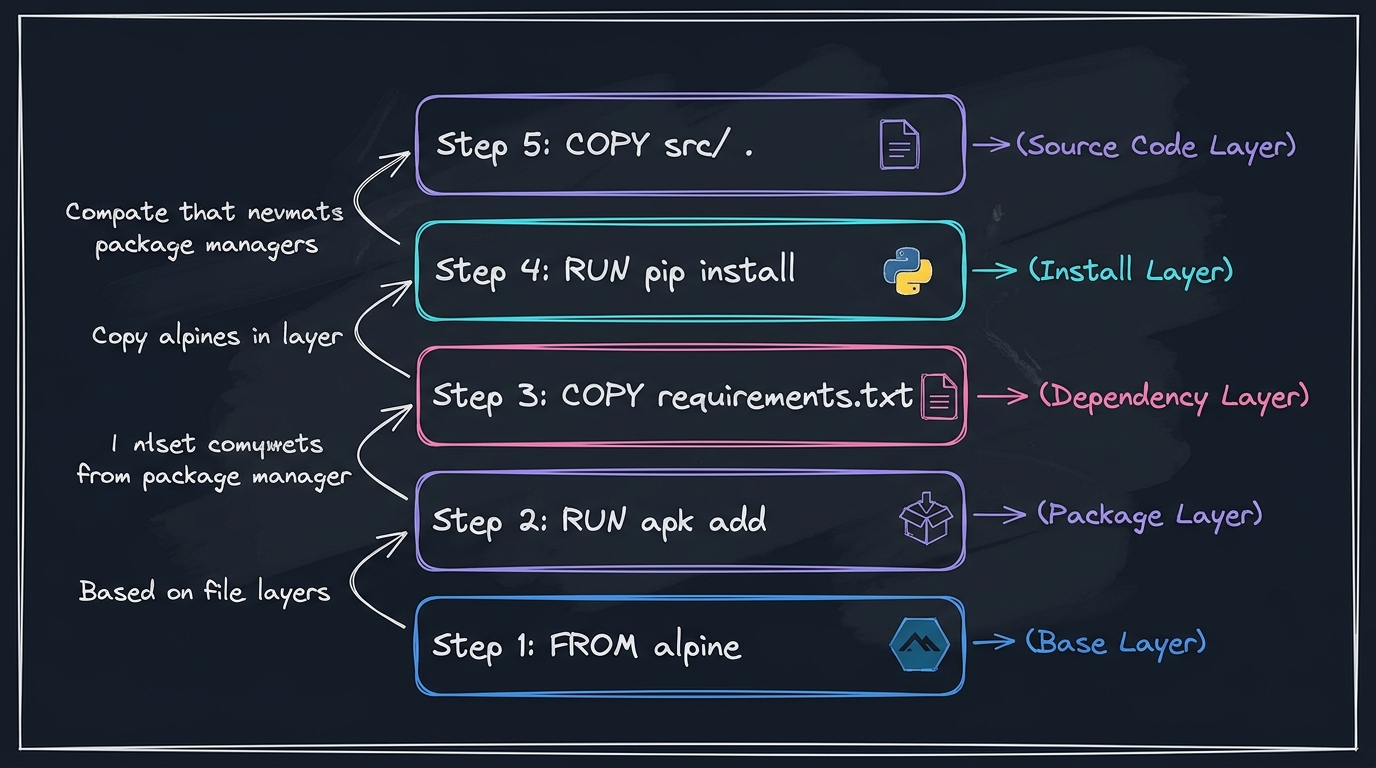
Docker Image Layer Build Stack

Docker builds images in a stack of read-only layers. If you modify a file in step 5, Docker will reuse cached layers from steps 1-4. To optimize build speeds, always copy package files and run dependency installs BEFORE copying your application source code.

---

Technical Q&As (Container Operations)

Q1: What is the difference between the COPY and ADD instructions in a Dockerfile? When should you use one over the other?

Answer: Both copy files, but their capabilities differ:

  • COPY: A simple, transparent command that copies local files or folders from the build machine context directly into the target container filesystem. It is the recommended instruction for almost all use cases.
  • ADD: A more complex command that has two additional capabilities:

1. It can retrieve files from remote URLs.

2. It automatically extracts tar archives (e.g., tar.gz, tar.xz) into the target folder.

  • *Best Practice*: Use COPY for predictability. If you need to download remote packages, use RUN curl or RUN wget to download and clean up tar archives in a single layer to keep image sizes small.

Q2: What is a Multi-stage build and how does it reduce container security risks and image sizes?

Answer: Traditional builds compile applications inside the final image, leaving build dependencies (like compilers, SDKs, test runtimes) in the container. This inflates image sizes and increases vulnerability surfaces.

  • Multi-Stage Build: Allows you to declare multiple FROM lines in a single Dockerfile. You compile and build your application in a heavy base stage (e.g., golang:1.21 or maven:3-openjdk), and then copy only the compiled static binaries or assets into a clean, minimal runtime stage (e.g., alpine or distroless).
  • *Example*:
# Stage 1: Build/Compile
FROM golang:1.21-alpine AS builder
WORKDIR /app
COPY . .
RUN go build -o main .

# Stage 2: Minimal Runtime
FROM alpine:3.18
WORKDIR /run
COPY --from=builder /app/main .
CMD ["./main"]

This reduces the image size from ~800MB to ~15MB and removes compilers that hackers could use to build scripts.

---

Production Troubleshooting Commands

Diagnosing Slow Container Startup

To check which process inside the container is consuming resources or blocked:

docker stats --no-stream
docker inspect --format='{{.State.Health.Log}}' 

Cleaning Up Unused Image Layers

To reclaim disk space occupied by dangling images, stopped containers, and unused builder caches:

docker system prune -a --volumes

Docker Architecture Interview whiteboarding Challenge

Interactive Troubleshooting Lab

The interviewer asks you to configure a network configuration where three containers on the same host can talk to each other by name, but are isolated from outside network queries.

production_manifest.yaml
# Stage 1: Build dependencies
FROM python:3.10-slim AS builder
WORKDIR /app
RUN apt-get update && apt-get install -y --no-install-recommends gcc build-essential
COPY requirements.txt .
RUN pip install --user --no-cache-dir -r requirements.txt

# Stage 2: Clean runtime
FROM python:3.10-slim
WORKDIR /app
COPY --from=builder /root/.local /root/.local
COPY . .
ENV PATH=/root/.local/bin:$PATH
EXPOSE 8000
CMD ["uvicorn", "main:app", "--host", "0.0.0.0"]

Diagnostic & Resolution Steps

Recommended remediation commands

To resolve this system outage, follow these step-by-step diagnostic and remediation instructions: 1. Create a user-defined bridge network: `docker network create internal-net`. 2. Launch all three containers attaching them to this network: `docker run --network=internal-net --name api-1 ...`. 3. Test host-name resolution between containers using the container names. Here is the clean, verified configuration file or script template demonstrating how to resolve this configuration drift or deploy the service correctly:

Interview Success Benchmarks for Docker

Core competencies & reference questions

To prepare effectively for the challenges of managing Docker, review the key domains and common test questions detailed below. These represent actual operational tasks expected of DevOps engineers in modern software environments.

Core Question: Describe the startup lifecycle of a service in this environment.

Explain how components verify network connections, synchronize states with configuration registries, and signal health back to the control plane.

Verification Checked

Scenario Question: How do you troubleshoot socket exhaustion or API latency issues?

Detail debugging steps including connection state counts, routing analysis, scaling policies, and file handle limits.

Verification Checked

Architecture Question: Explain how this technology guarantees idempotency.

Provide details on declarative configurations, state management comparisons, and how the target engine updates only modified parameters.

Verification Checked

Frequently Asked Questions

Technical reference answers

Q: What are the most common Docker interview questions?

Expect questions on Docker vs VMs, how to reduce image size, difference between COPY and ADD, and how container networking works.

Q: How do I explain Docker multi-stage builds in an interview?

Explain that they allow you to compile code in a temporary stage and copy only the compiled binaries to the final image, minimizing size.

Q: What is the difference between CMD and ENTRYPOINT?

CMD provides default arguments that can be overridden by the CLI, whereas ENTRYPOINT defines the executable that runs by default.

Ready to test your skills in real-time?

Take the next step in your cloud career. Access our interactive simulators, test your command-line capabilities on live terminals, run script execution pipelines, and verify your configuration files instantly.

Practice Flashcards for Docker  →