
SM
Written by Sachin Mehta • Founder & Principal Cloud Architect Principal cloud architect and scalable container specialist.
Phase 1: Containerization Foundations (Weeks 1-2)
Before diving into Kubernetes, you must understand containers. Do not skip this step!
- Core Concepts: Linux namespaces, cgroups, copy-on-write filesystem structures.
- Hands-on Tools: Write clean Dockerfiles, build multi-stage images, manage container ports, and mount host directories.
- Verification Project: Build a two-container app (a Python API backend and a Redis cache database) and run them locally using Docker Compose, configuring isolated bridge networks.
---
Phase 2: Single-Node Kubernetes & Manifest Basics (Weeks 3-5)
Transition your applications into container orchestrators.
- Local Clusters: Install Minikube, Kind (Kubernetes in Docker), or K3s on your development machine.
- Basic Resources: Learn to write and debug Pods, ReplicaSets, and Deployments.
- Service Routing: Understand how ClusterIP exposes services inside the cluster, how NodePort opens ports on hosts, and how Ingress routes HTTP traffic from outside.
- Verification Project: Convert your Docker Compose YAML files into Kubernetes declarative manifests. Deploy them, verify service endpoint resolution, and scale replicas up and down using:
kubectl scale deployment python-api --replicas=5---
Phase 3: Persistent Storage, Configurations, & Secrets (Weeks 6-8)
Move beyond stateless services. Learn how to manage configuration drifts and persist data.
- ConfigMaps & Secrets: Mount environment variables and configurations dynamically. Update variables without rebuilds.
- Storage Primitives: Understand StorageClasses, PersistentVolumes (PV), and PersistentVolumeClaims (PVC). Configure volume mounts on containers.
- Workload Controllers: Learn when to use StatefulSets (for databases requiring stable network IDs) versus DaemonSets (for system monitoring agents running on every worker node).
---
Phase 4: Cluster Administration & CKA Preparation (Weeks 9-12)
Take control of cluster nodes, security, and updates.
- Control Plane Mechanics: Troubleshoot kubelet daemon failures, backing up and restoring the etcd database state, and cluster version upgrades.
- Scheduling Constraints: Apply node selectors, taints, tolerations, and node affinity rules.
- Security & Network Policies: Write network policies to isolate namespace traffic. Limit pod privileges using SecurityContexts.
- Verification Project: Bootstrap a multi-node Kubernetes cluster from scratch on virtual machines using kubeadm, write custom network isolation policies, and perform a rolling master node upgrade.
---
Phase 5: Platform Engineering & GitOps Workflows (Weeks 13+)
Prepare for real-world enterprise architectures.
- Helm Package Manager: Package applications, parameterize values, and manage releases.
- GitOps Continuous Delivery: Deploy controllers like ArgoCD or FluxCD to synchronize cluster state directly with git repositories, eliminating manual
kubectl applycommands. - Observability Stacks: Deploy Prometheus to scrape container metrics, and configure Grafana dashboards to monitor cluster health.
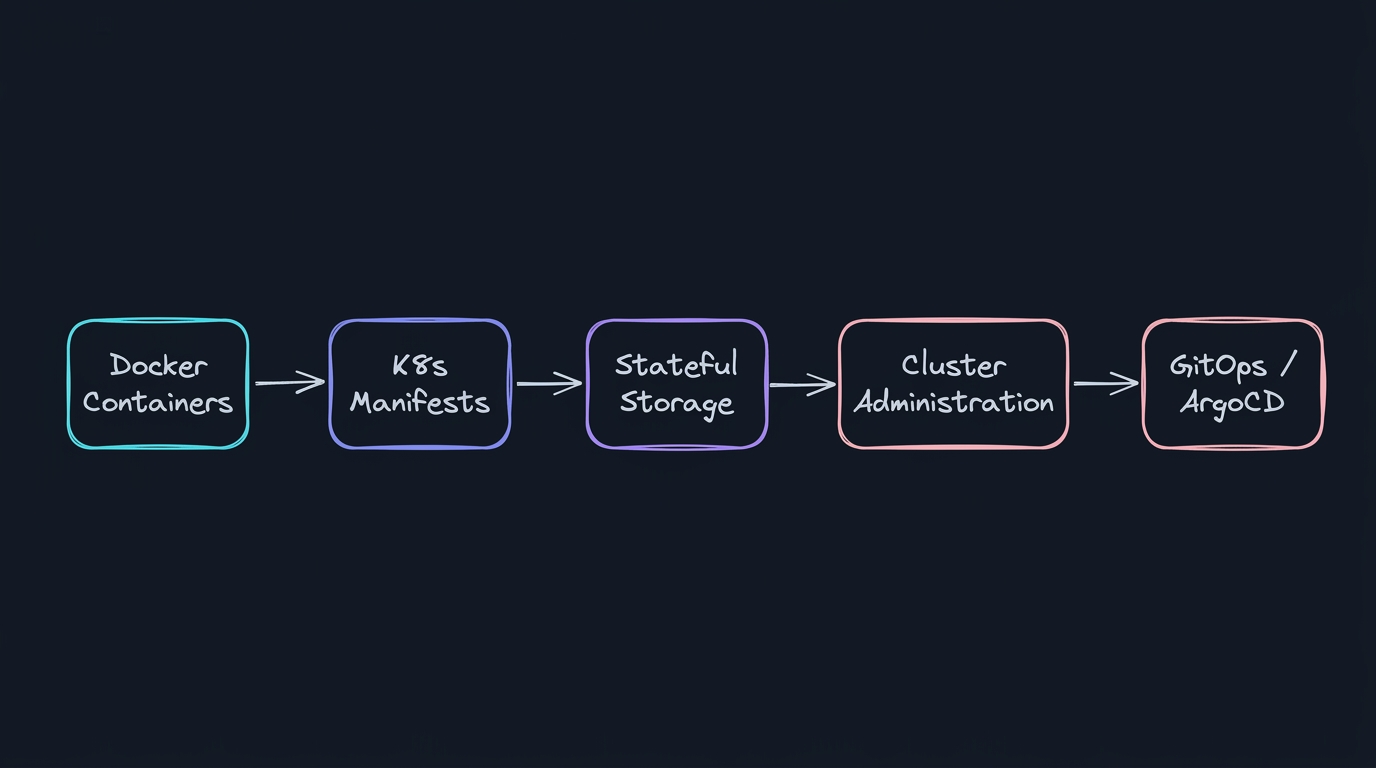
This step-by-step track ensures you build hands-on runtime confidence before moving to advanced configurations.